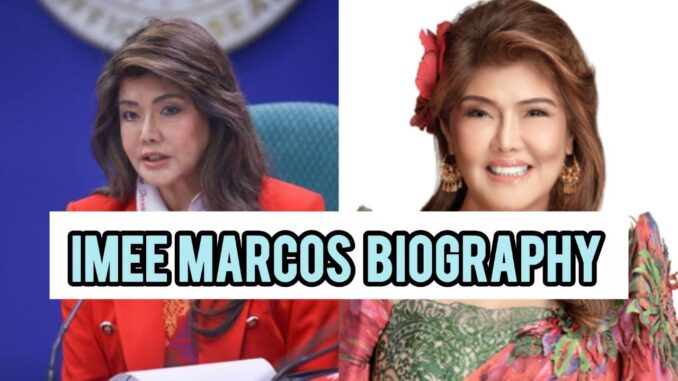
Imee Marcos Biography
Imee Marcos was born on November 12, 1955, in Mandaluyong, Philippines. She is the eldest daughter of the late strongman-president Ferdinand Marcos and former First Lady Imelda Marcos. She is known for her long political career spanning congress, the Ilocos Norte governorship, and two Senate terms, as well as for the controversies surrounding her family’s martial law legacy and her education credentials. Imee Marcos is 70 years old as of 2026.
Her early years unfolded against the backdrop of martial law, a period the Marcos administration declared in 1972 that suspended civil liberties, silenced political opponents, and tightened the family’s grip on nearly every facet of Filipino life. For young Imee, childhood meant privilege on a scale most Filipinos could not imagine — state banquets, foreign travel, private schooling, and proximity to the absolute levers of national authority. Yet that same privilege would become a lifelong lens through which critics would view everything she said and did.
Her formal education has been one of the most debated aspects of her biography. She reportedly attended Saint Pedro Poveda College, Assumption Convent in Manila, and the International School Manila during her formative years. She later enrolled at Princeton University in the United States and at the University of the Philippines Diliman. The catch — and it is a significant one — is that official records from both institutions have never confirmed that she earned a degree from either. The discrepancy between what she claimed on official documents and what the records showed became a recurring political liability, fueling accusations of credential misrepresentation that dogged her through multiple electoral campaigns.
Imee Marcos Career
Imee Marcos entered the world of formal politics while still in her early twenties, during the height of her father’s dictatorship. She served as chairperson of Kabataang Barangay, the state-sponsored youth organization that her father had established as a vehicle for political mobilization. At the time, critics regarded the organization as an instrument of propaganda rather than genuine civic youth development, but for Imee it served as an apprenticeship in the mechanics of organizing and governance. She later served as a member of the Batasang Pambansa, the martial law-era parliament, cementing her place in the machinery of her father’s government.
When the People Power Revolution of 1986 brought that machinery crashing down, the Marcos family fled the Philippines into exile in Hawaii. It was a sudden, total reversal of fortune — from untouchable rulers to exiled figures hunted by creditors, lawyers, and human rights advocates. Ferdinand Marcos died in exile in 1989, but the family’s political story was far from over. Imee and her mother Imelda returned to the Philippines in 1991, and against what many observers considered long odds, they began the slow, methodical work of rehabilitating the Marcos name.
Imee’s political resurgence was built on the home turf of Ilocos Norte, the northern Philippine province that had always been the family’s political stronghold. She won a seat in the House of Representatives in 1998, representing the second district of Ilocos Norte, and held that seat until 2007 — a nine-year run in congress that allowed her to rebuild ties and establish her own political identity separate from the more flamboyant image of her mother.
She then moved into local executive leadership, serving as governor of Ilocos Norte from 2010 to 2019, a tenure during which she invested in tourism, agricultural development, and cultural preservation initiatives that earned her a degree of respect even among those skeptical of her family name.
In 2019, she made the leap to the national upper house, winning a Senate seat in an election that coincided with her brother Ferdinand “Bongbong” Marcos Jr.’s failed bid for the vice presidency — a race he lost and subsequently contested in court. Imee won re-election to the Senate in 2025, demonstrating durable electoral appeal that now extends well beyond the Ilocos region. Beyond politics, she has also worked as a film producer, particularly in the 1970s when she was involved in state-sponsored cultural and cinema initiatives under her father’s administration, though those productions remain controversial for their propaganda dimensions.
By 2026, Imee occupies a complicated political position. Her brother Bongbong is the sitting President of the Philippines, yet she has repeatedly shown a willingness to chart an independent course — sometimes publicly contradicting or challenging administration positions in ways that few senators connected to the ruling family would dare. That independence, whether genuine or tactical, has made her one of the more unpredictable voices in the Philippine Senate.
Imee Marcos Personal life
Imee Marcos was married to Tommy Manotoc, a former professional golfer and basketball coach who was himself a notable public figure in Philippine sports. Their relationship, however, was never straightforward. Tommy Manotoc had been previously married, and in a predominantly Catholic country where divorce remained illegal, the legal and moral dimensions of their union attracted considerable public scrutiny. The couple eventually separated, though the exact legal status of their relationship was long a matter of ambiguity given the Philippine legal context.
Together, Imee and Tommy have three sons. The most politically prominent among them is Matthew Manotoc, who followed the family’s governing tradition by entering politics and eventually serving as governor of Ilocos Norte — the very position his mother once held. Matthew’s political career is seen by many analysts as an extension of the Marcos political dynasty into a new generation, ensuring the family’s foothold in the north of the Philippines continues well into the future.
On matters of faith and ethnicity, Imee’s background is consistent with mainstream Filipino identity. She is of Filipino Austronesian descent and is widely understood to practice Roman Catholicism, the faith that dominates Philippine society. Religion, however, has not been a prominent theme in her public persona, which tends to center far more on political positioning than on personal devotion.
Her personal relationship with her brother, President Bongbong Marcos, is one of the most closely watched dynamics in contemporary Philippine politics. In May 2026, Imee publicly raised alarms about alleged efforts by certain political groups to push for constitutional amendments that would extend the terms of elected officials — including the President — through 2031, effectively suspending the 2028 national elections.
Bongbong responded sharply, calling the claim an example of “fake news” and suggesting his sister’s staff had fed her bad information. “She should fire her staffer who gave her that information,” he said during a press conference in Tokyo. The public exchange between siblings was remarkable in its candor and signaled that, even within the Marcos family, political tensions run deep.
Imee Marcos Controversies and Scandals
No biography of Imee Marcos is complete without a frank examination of the controversies that have followed her throughout her life, and there are many. The first and perhaps most foundational concerns the era in which she rose to prominence. Imee was an active participant in governance during the martial law period, a time characterized by widespread human rights abuses, extrajudicial killings, torture of political dissidents, and the systematic plundering of the Philippine treasury. While she has never been personally convicted of crimes related to that era, her involvement in the machinery of that government — and her long reluctance to acknowledge its abuses — remains a source of deep moral outrage for many Filipinos.
One case that has specifically attached itself to her name is the Archimedes Trajano case. Trajano, a student activist, was allegedly tortured and murdered in 1977 after publicly questioning Imee during a forum. A U.S. federal court later found against her in a civil case brought by the Trajano family, awarding damages and establishing a legal record that human rights advocates have cited for decades. Imee has disputed her direct involvement, but the case has never fully receded from her public narrative.
The education controversy — her claimed but unverified degrees from Princeton and the University of the Philippines — struck many voters as emblematic of a broader pattern of misrepresentation. In a country where educational credentials carry significant social weight, the revelation that her claimed qualifications could not be verified by official records damaged her credibility, particularly among educated middle-class voters.
More recently, in 2026, Imee found herself at the center of a political firestorm when she alleged that certain unnamed political groups were pushing for a “no-election” scenario in 2028 — a plan that would involve constitutional amendments to extend the terms of sitting officials, including the president, through 2031. Her brother the President flatly denied any such plan existed, calling her claims fake news and publicly embarrassing her on the international stage.
Meanwhile, Imee’s response to Ombudsman charges filed against her Senate majority allies — including Sen. Jinggoy Estrada and others — was to brand the prosecutions “political persecution,” arguing that the timing of the cases revealed a deliberate attempt by administration-aligned senators to weaken the new Senate majority bloc. The political maneuvers surrounding Senate leadership, the Ombudsman cases, and the public Marcos sibling dispute collectively painted a portrait of a woman navigating extremely high-stakes political terrain with her usual combination of boldness and controversy.
Conclusion
Imee Marcos is, in almost every sense, a product of the Philippines’ most turbulent political history — born into absolute power, exiled, returned, and rebuilt into a durable electoral force. She is a politician who simultaneously benefits from her family’s name and is burdened by it, who has at times broken from her brother’s administration in ways that suggest genuine independence, and who remains deeply controversial among Filipinos who lived through or bear the legacy of martial law. Whatever one thinks of her politics or her past, she is undeniably one of the most consequential figures in Philippine public life today.
FAQs
Did Imee Marcos graduate from Princeton University?
Official records from Princeton University have not confirmed that Imee Marcos earned a degree from the institution. The claim that she graduated from Princeton — as well as from the University of the Philippines Diliman — was widely disputed and became a major political controversy during her electoral campaigns.
What is the relationship between Imee Marcos and President Bongbong Marcos?
Imee Marcos is the elder sister of President Ferdinand “Bongbong” Marcos Jr. While they belong to the same powerful political dynasty, their relationship has shown public strain, most notably in May 2026 when Imee made allegations about a “no-election” conspiracy that her brother sharply denied and called fake news.
What was the Trajano case and why does it matter for Imee Marcos?
The Trajano case refers to a U.S. civil lawsuit in which a federal court found Imee Marcos liable in connection with the torture and murder of student activist Archimedes Trajano in 1977. Trajano had publicly questioned her at a forum during the martial law era. The case remains a central reference point for human rights advocates discussing her legacy.
Who are Imee Marcos’s children?
Imee Marcos has three sons with former husband Tommy Manotoc. Her most publicly prominent son is Matthew Manotoc, who entered politics and served as governor of Ilocos Norte, continuing the Marcos family’s political tradition in the province.

Richardson Gray is a writer who specializes in legal and compliance basics for solopreneurs, as well as the growing second-hand and circular economy. With 21 years of experience, he has written extensively about business trends, sustainable consumption, and practical strategies for independent entrepreneurs. He holds both a BSc and an MSc in Economics, giving him a strong understanding of business systems, market behavior, and financial practices.
Leave a Reply