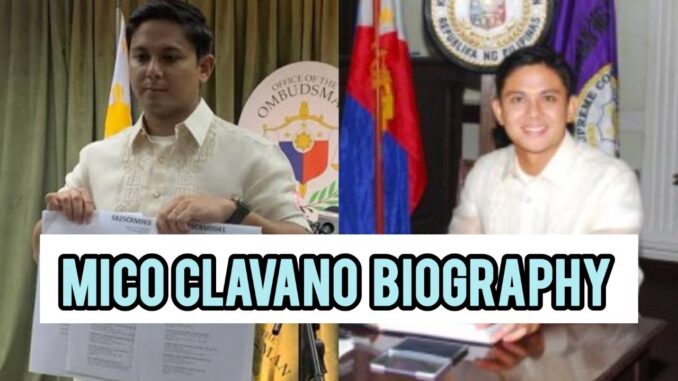
Mico Clavano Biography
Mico Clavano was born on April 11, 1982, in Quezon City, Philippines. Mico is the Assistant Ombudsman of the Philippines. He serves as a senior official and public spokesperson for the Office of the Ombudsman, the constitutional body responsible for investigating and prosecuting government officials accused of corruption and misconduct. Mico Clavano is 44 years old as of 2026.
Clavano pursued a legal education with seriousness of purpose, going on to earn his law degree and pass the Philippine bar examination. He built his early career methodically, developing expertise in public accountability law and anti-corruption mechanisms — fields that were not merely academic interests but genuine vocations. The Office of the Ombudsman, the constitutional body tasked with investigating and prosecuting public officials accused of corruption and misconduct, eventually became his professional home and the institution through which he would rise to national prominence.
He climbed steadily through the ranks of the Ombudsman’s office over the years, earning a reputation as a careful, precise legal mind who communicated complex legal matters in plain language. That talent — the ability to make intricate procedural and evidentiary issues accessible to the public — proved invaluable as the Ombudsman’s office became increasingly central to the biggest corruption cases shaking Philippine politics. By the time he reached the rank of Assistant Ombudsman, Mico Clavano had become the face of the institution in its most high-profile public briefings, a role he carries into 2026 with considerable visibility.
Mico Clavano Career
Clavano’s career at the Office of the Ombudsman represents the fullest expression of his professional ambitions. The Ombudsman is the Philippines’ primary anti-graft watchdog, empowered by the 1987 Constitution to investigate public officials, file charges before the Sandiganbayan (the country’s anti-graft court), and protect citizens from abuse of power. As Assistant Ombudsman, Clavano occupies one of the senior-most positions in that institution, placing him at the center of some of the nation’s most consequential legal proceedings.
His work requires him to balance two demanding roles simultaneously. On one hand, he oversees and guides complex fact-finding investigations that may stretch across multiple agencies, involve thousands of documents, and implicate powerful figures who have resources to mount sophisticated legal defenses. On the other hand, he serves as a public spokesperson for the institution, appearing at press briefings and giving radio interviews where he must explain — clearly, accurately, and without prejudging ongoing proceedings — what the office has found, what it has filed, and what it is still investigating.
In May 2026, Clavano stepped into the national spotlight in a major way when the Office of the Ombudsman filed non-bailable plunder and graft charges before the Sandiganbayan against Senator Jinggoy Estrada and former Department of Public Works and Highways (DPWH) Secretary Manuel Bonoan. The charges, which Clavano announced at a press briefing, centered on alleged illicit payouts amounting to PHP 573 million funnelled through flood control infrastructure projects in exchange for kickbacks and commission fees.
Three engineers from the DPWH’s National Capital Region office were also named as respondents. Clavano described the scheme as one in which “substantial public funds were deliberately funnelled into designated infrastructure projects in exchange for predetermined commission fees or kickbacks” — language that reflected the Ombudsman’s position that the evidence was clear and compelling enough to warrant the most serious charges available under Philippine law.
The investigation that produced those charges was extensive. It involved the Department of Justice (DOJ) and the National Bureau of Investigation (NBI), and was the product of months of document review, witness interviews, and financial tracing. Clavano noted that the Ombudsman recommended no bail for the respondents and would seek a hold departure order to prevent them from leaving the country while the case proceeded. Several other officials originally named in the complaint were either dropped — in the case of former DPWH Undersecretary Cathy Cabral, who died — or formally excluded after agreeing to become state witnesses.
Beyond the Estrada and Bonoan charges, Clavano also became a central public voice in the Ombudsman’s broader investigation into what it described as a “grand conspiracy” involving alleged budget manipulation tied to flood control projects. The investigation extended to Leyte 1st District Representative Ferdinand Martin Romualdez, the former Speaker of the House of Representatives.
Clavano was candid in a radio interview with DZMM that there was a “school of thought” within the Ombudsman’s office that Romualdez, by virtue of his role as House Speaker, exercised “functional control” over the House Committee on Appropriations — control that, under the theory of command responsibility, could make him legally accountable for irregularities carried out under that committee’s authority even if he was not physically present at every decision point.
Clavano also clarified, after initial confusion surrounding the Ombudsman’s attempt to serve a subpoena to the House of Representatives, that the apparent refusal to receive the subpoena was a “miscommunication” rather than deliberate obstruction. He confirmed that House leadership had subsequently expressed willingness to cooperate with the investigation and that the Ombudsman expected to receive the minutes, attendance lists, and transcripts it had sought. He was equally precise in explaining the legal concept at the heart of the broader case — that conspiracy, under Philippine law, is not a standalone crime but a mode of committing a crime, meaning that proving a conspiracy to commit plunder requires establishing the underlying plunder itself.
Mico Clavano Personal life
Mico Clavano is married to Sam Sadhwani. Clavano belongs to a generation of Filipino legal professionals who came of age during the post-Marcos reform era, when the 1987 Constitution and its independent constitutional commissions — including the Ombudsman — were still relatively young institutions working to establish credibility and permanence. That generational context shaped the values he brought to his career: a belief in due process, transparency, and the rule of law as genuine governing principles rather than abstract ideals.
His communication style in public settings is notably measured. He does not sensationalize, does not editorialize beyond what his role permits, and consistently redirects questions about political motivations back to the legal process. That professional discipline has earned him respect across the political spectrum, even among those whose principals are targets of Ombudsman investigations, as a straight-shooter who says what the office can support and acknowledges what is still under investigation.
Mico Clavano Controversies
The most significant controversy surrounding Mico Clavano is not personal but institutional — and it concerns the explosive political fallout from the Ombudsman’s handling of the flood control scandal cases. Senator Jinggoy Estrada, upon learning of the charges filed against him, publicly questioned the speed of the prosecution, arguing that cases were filed barely a week after the DOJ issued its resolution and that the Ombudsman appeared to skip a thorough independent fact-finding review it had earlier promised.
Estrada’s camp raised due process concerns and pointed to a letter from the Senate Legislative Budget Research and Monitoring Office indicating that there was no record of him making any budget insertion in the 2025 national budget — a piece of evidence he said was disregarded. While these criticisms were directed at the institution as a whole, Clavano, as its public face, bore the brunt of explaining and defending the process.
The controversy deepened when Clavano publicly stated that there was a “school of thought” within the Ombudsman pointing to former House Speaker Martin Romualdez as the mastermind of the flood control scheme on the basis of “functional control.” Romualdez’s camp responded forcefully, with his spokesperson arguing that there is no such thing as “functional control” over the national budget process and that the budget passes through the Executive, House, Senate, bicameral conference, and presidential approval — a layered institutional process that no single official can dictate. Romualdez himself argued that command responsibility is “far more logically relevant in the Executive branch” where actual project implementation, procurement, and disbursement occur.
Clavano’s public attribution of a “school of thought” — before formal charges were filed against Romualdez — drew criticism from legal observers who argued that premature public characterizations of suspects as masterminds risk prejudicing proceedings and violating the presumption of innocence. For his part, Clavano was careful to frame the statement as an internal working theory under a still-active fact-finding investigation rather than a formal finding. Nevertheless, the episode illustrated the razor-thin line that the Assistant Ombudsman walks between transparency — which the public and media demand — and procedural fairness, which the legal system requires.
Conclusion
Mico Clavano stands today as one of the most consequential legal figures in the Philippines — not because he holds elected power or commands armies, but because the institution he represents holds the authority to hold the powerful accountable. His steady, evidence-anchored approach to one of the most politically charged corruption investigations in recent Philippine history has made him a credible voice in a landscape often dominated by noise. Whether the cases his office has built will survive legal challenge and result in convictions remains to be seen.
FAQs
What cases is Mico Clavano handling in 2026?
In 2026, Clavano has been publicly associated with the Ombudsman’s prosecution of plunder and graft charges against Senator Jinggoy Estrada and former DPWH Secretary Manuel Bonoan over the flood control scandal, as well as the broader investigation into alleged budget manipulation involving former House Speaker Martin Romualdez.
What is the flood control scandal that Mico Clavano announced?
The flood control scandal involves allegations that PHP 573 million in public funds were funnelled into infrastructure projects in exchange for kickbacks and commission fees. The Ombudsman filed non-bailable plunder and graft charges before the Sandiganbayan against Senator Estrada, former DPWH Secretary Bonoan, and several DPWH engineers in connection with the scheme.
What did Mico Clavano say about Martin Romualdez?
Clavano stated in a radio interview that there is a “school of thought” within the Ombudsman’s office that former House Speaker Romualdez exercised “functional control” over the House Committee on Appropriations, which could make him responsible under the theory of command responsibility. He clarified this was part of an ongoing fact-finding investigation and not a formal charge at the time of the statement.

Richardson Gray is a writer who specializes in legal and compliance basics for solopreneurs, as well as the growing second-hand and circular economy. With 21 years of experience, he has written extensively about business trends, sustainable consumption, and practical strategies for independent entrepreneurs. He holds both a BSc and an MSc in Economics, giving him a strong understanding of business systems, market behavior, and financial practices.
Leave a Reply