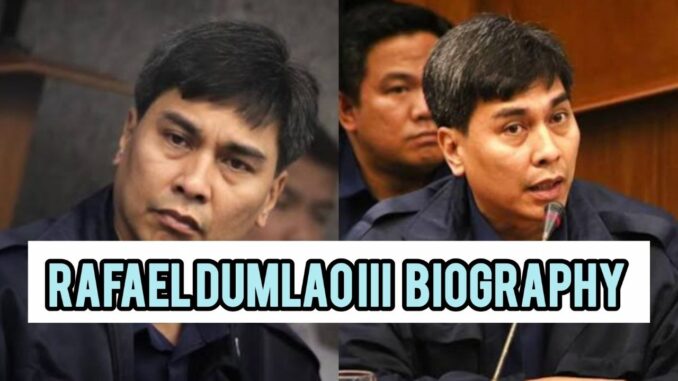
Rafael Dumlao III Biography
Col. Rafael Dumlao III was born on January 12, 1975, in Quezon City, Philippines. He is a dismissed Philippine National Police Lieutenant Colonel, and was convicted of the kidnapping and murder of South Korean businessman Jee Ick-joo in 2016 and was arrested as a fugitive on June 9, 2026, after evading authorities following the Supreme Court’s affirmation of his conviction. Rafael Dumlao III is 51 years old as of 2026.
He has no known public statements about his family, upbringing, or education beyond what his police career trajectory implies — namely that he went through the training and credentialing process required to reach senior officer rank in the PNP. His family life has been deliberately kept out of the media, both by his own design and by the nature of the case against him, which made any association with him a sensitive matter. What is known publicly about Rafael Dumlao III is defined almost entirely by the crime he was convicted of and the years he spent evading justice for it.
Rafael Dumlao III Police Career
Rafael Dumlao III built his career in the Philippine National Police over many years, eventually reaching a position of significant authority and responsibility within the Anti-Kidnapping Group. The AKG is tasked with investigating kidnapping cases, coordinating rescue operations, and dismantling organized crime networks involved in abduction. It is, by its very nature, one of the units that Filipino citizens are supposed to be able to trust most — the people who go in when someone has been taken. The bitter irony at the heart of the Dumlao story is that a man entrusted with that mission allegedly used his position, his authority, and his knowledge of police operations to commit the very crime he was supposed to prevent.
During the early years of former President Rodrigo Duterte’s administration — which began in 2016 and was marked by an aggressive, deadly anti-drug campaign known as Oplan Tokhang — Dumlao was an active senior officer with access to intelligence, personnel, and the kind of institutional cover that made misconduct easier to conceal.
Oplan Tokhang, whose name comes from the Cebuano words for “knock” and “plead,” was a door-to-door anti-drug operation that gave police officers enormous discretionary power. Official statistics acknowledge around 6,000 deaths during the drug war, while human rights organizations put the figure as high as 30,000. Interior Secretary Jonvic Remulla, speaking after Dumlao’s arrest, said the case was “the result of the abuses of Oplan Tokhang,” adding that the operation “gave too much licence to the PNP operatives to do things at their whim without the process of law.”
Dumlao’s name became publicly attached to one of the most shocking individual cases of police criminality in that era. After his role in the Jee Ick-joo killing came to light, he was dismissed from the PNP and faced criminal prosecution. The legal process that followed stretched across nearly a decade, through an initial acquittal, a dramatic appellate reversal, and a Supreme Court affirmation of his conviction — a journey through the Philippine justice system that tested the limits of accountability and ultimately, in June 2026, ended with his capture.
Rafael Dumlao III Scandals and controversies
The case at the center of every controversy surrounding Rafael Dumlao III is the kidnapping and murder of Jee Ick-joo, a South Korean businessman. On October 18, 2016, Jee was abducted from his residence in Angeles City, Pampanga, by police officers operating under the cover of an anti-drug operation.
He was taken not to a police station for processing — but to Camp Crame, the headquarters of the Philippine National Police in Quezon City, one of the most secure and monitored law enforcement facilities in the country. Inside those walls, Jee was strangled to death. His body was then cremated, and his ashes were flushed down a toilet to eliminate all physical evidence of the crime. His family, unaware of what had actually happened, was meanwhile being extorted — the kidnappers demanded ransom money while Jee was already dead.
The case became a global scandal. That a foreign national could be kidnapped by active-duty Philippine police officers, murdered inside police headquarters, and his remains disposed of in such a deliberately dehumanizing manner — all while his family was being extorted — was a blow to the credibility of both the Duterte administration’s drug war and the PNP as an institution. South Korea, a close Philippine ally, reacted with outrage, and the case drew sustained international attention at a moment when the drug war was already under intense scrutiny from human rights organizations around the world.
Dumlao was identified as the alleged mastermind of the scheme. In June 2023, an Angeles City trial court acquitted him — a verdict that was immediately and widely condemned. The Court of Appeals overturned that acquittal in July 2024, declaring that the lower court had committed a “grave abuse of discretion” and that its ruling was a “mockery of justice.” Dumlao was found guilty of kidnapping with homicide and sentenced to a minimum of 30 years in prison. The Supreme Court of the Philippines affirmed that conviction in 2025. His co-accused, Chief Master Sergeant Ricky Sta. Isabel and NBI errand boy Jerry Omlang, were sentenced to reclusion perpetua without parole. Another co-accused, Executive Master Sergeant Roy Villegas, turned state witness.
Rather than surrender, Dumlao went into hiding after the Supreme Court’s affirmation. He became a fugitive — a convicted murderer with a sentence of at minimum three decades in prison, using his knowledge of how law enforcement works to stay one step ahead of the very institution he once served. The Department of the Interior and Local Government offered a reward of PHP 1.09 million for information leading to his arrest.
Investigators surveilled his movements for approximately three weeks before confirming his location. On the morning of June 9, 2026, the Criminal Investigation and Detection Group’s National Capital Region unit moved on a house in Pasong Tamo, Quezon City, broke down the door, and found Dumlao asleep — with a 9mm pistol registered to another person lying nearby. He was taken into custody without resistance.
Interior Secretary Remulla revealed that investigators had tracked Dumlao partly through his daughter’s wedding — he watched it via Facebook Live rather than attend in person, but the movement of people around the house where he was hiding confirmed his presence. His cell phone and laptop were seized for forensic examination to determine whether anyone had helped shelter or support him during his time as a fugitive. The South Korean ambassador to the Philippines, the South Korean president, and Jee’s widow Choi Kyung Jin were all formally notified of the arrest. The South Korean president sent congratulations to Manila.
Conclusion
Rafael Dumlao III’s story is a case study in the consequences when institutional power is divorced from accountability. He was given authority to protect people from kidnappers and used it instead to become one. The Philippine justice system, despite the years it took, ultimately held. His arrest in June 2026 — more than nine years after Jee Ick-joo was murdered inside a police headquarters — brought a measure of resolution to one of the most internationally embarrassing crimes in the history of the PNP. Whether the broader lessons of his case translate into lasting institutional reform remains the open question that Philippine law enforcement will have to answer in the years ahead.
FAQs
What did Rafael Dumlao III do?
Rafael Dumlao III was convicted as the alleged mastermind in the kidnapping and killing of South Korean businessman Jee Ick-joo in October 2016. Jee was abducted in Angeles City under the guise of a police anti-drug operation, taken to Camp Crame — the PNP headquarters — strangled to death, cremated, and his ashes flushed down a toilet while his family was being extorted for ransom.
Was Rafael Dumlao III found guilty?
Yes. Although a trial court initially acquitted him in June 2023, the Court of Appeals overturned that acquittal in July 2024, calling it a “grave abuse of discretion.” The Supreme Court of the Philippines affirmed the conviction in 2025. Dumlao was sentenced to a minimum of 30 years in prison for kidnapping with homicide.
When and where was Rafael Dumlao III arrested?
Rafael Dumlao III was arrested on the morning of June 9, 2026, at a house in Pasong Tamo, Quezon City, Philippines. He was found asleep with a loaded 9mm pistol nearby. The CIDG NCR conducted the operation after approximately three weeks of surveillance.
Who was Jee Ick-joo and what happened to him?
Jee Ick-joo was a South Korean businessman who was kidnapped from his home in Angeles City, Pampanga, on October 18, 2016, by Philippine police officers posing as anti-drug operatives. He was taken to Camp Crame, the PNP headquarters, where he was strangled to death. His body was cremated and his ashes were flushed down a toilet to destroy evidence. His family was simultaneously being extorted for ransom. The case became one of the most shocking police corruption scandals in Philippine history.

Richardson Gray is a writer who specializes in legal and compliance basics for solopreneurs, as well as the growing second-hand and circular economy. With 21 years of experience, he has written extensively about business trends, sustainable consumption, and practical strategies for independent entrepreneurs. He holds both a BSc and an MSc in Economics, giving him a strong understanding of business systems, market behavior, and financial practices.
Leave a Reply